Key Findings
Finding 01
The disclosure quality gap is vast — and addressable
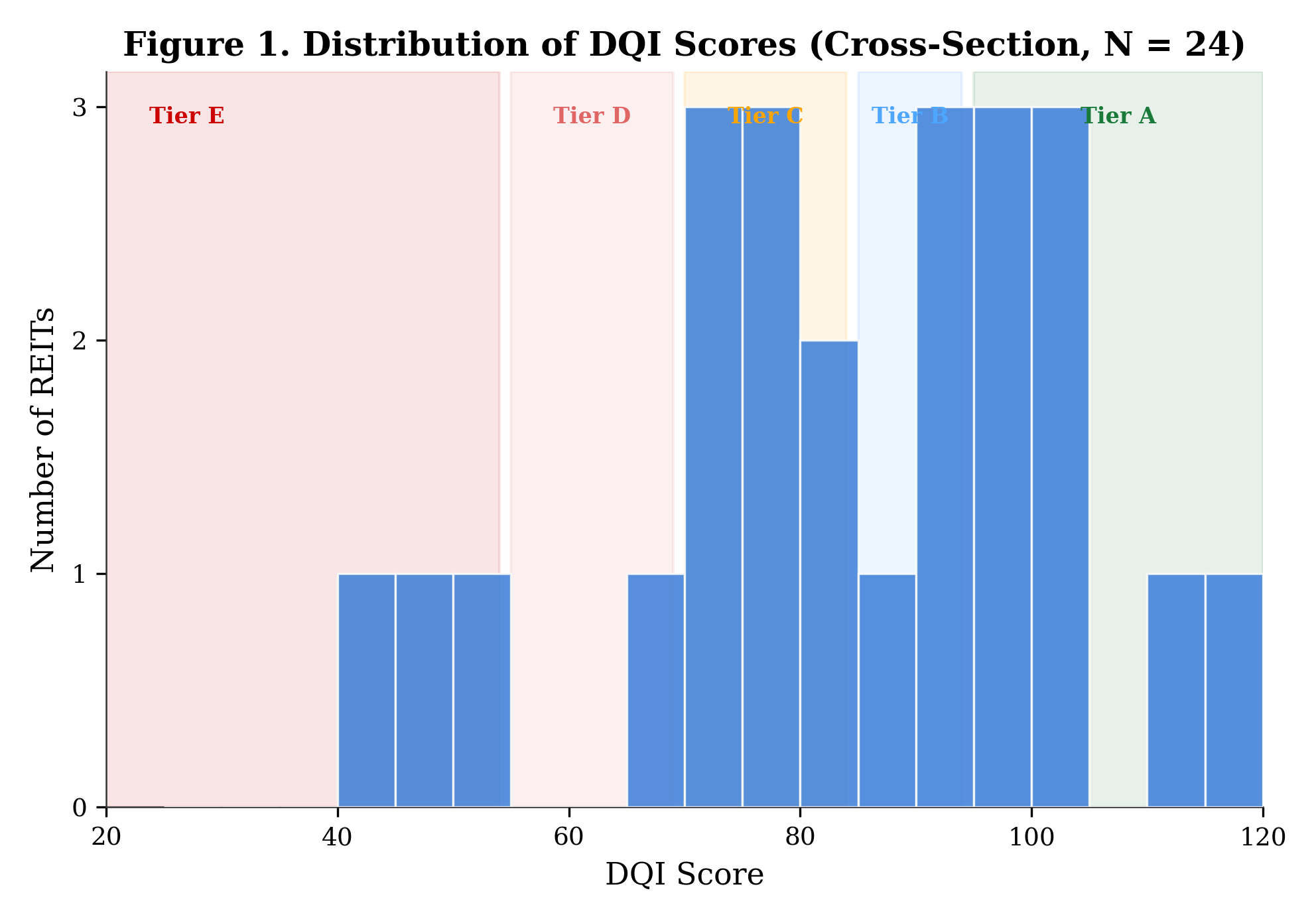
Across the complete population of UK listed REITs, DQI scores range from 115 (Landsec) to 43 (Custodian) — a 72-point gap on a 120-point scale. Eight companies (33%) achieve Tier A (Sector Leader); three (13%) remain in Tier E (Pre-Disclosure). The gap is not determined by sector: every major sub-sector contains at least one Tier A or B company.
Finding 02
Management structure is a red herring
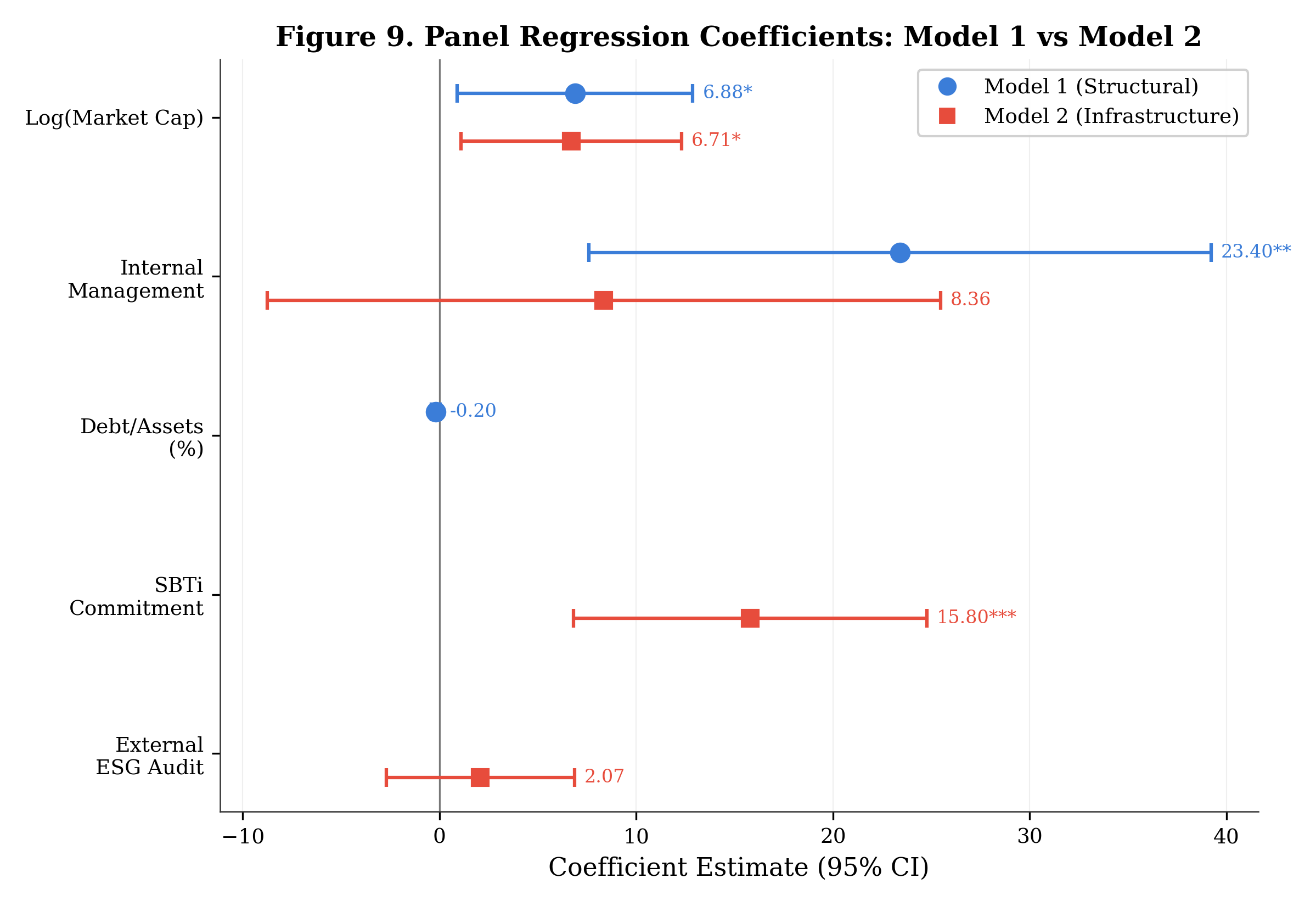
Internally managed REITs score 32 points higher than externally managed ones (88.3 vs 56.0, p=0.001). This appears structural — but it isn't. When SBTi commitment and external assurance are controlled for in panel regression, the management structure effect drops to zero (β=8.4, not significant). The gap is entirely mediated by infrastructure choices.
Finding 03
SBTi commitment is the strongest quality predictor
Science Based Targets initiative commitment adds approximately 16 DQI points (β=15.8, p<0.001), controlling for firm size and management structure. SBTi validation functions as a costly signal that structurally compels specific, methodology-documented, auditable disclosure — the attributes the DQI scores at its highest level.
Finding 04
Commercial ESG ratings miss what matters
The DQI correlates with LSEG ESG ratings (ρ=0.892) but diverges systematically. Companies investing in reporting infrastructure (GPE: DQI 99, LSEG B+) are undervalued by commercial ratings, while companies with broad policies but weak infrastructure (Safestore: DQI 73, LSEG A−) are overvalued. Ratings reward policy breadth; the DQI captures disclosure depth.
Finding 05
Quality is improving — but voluntary mechanisms have a ceiling
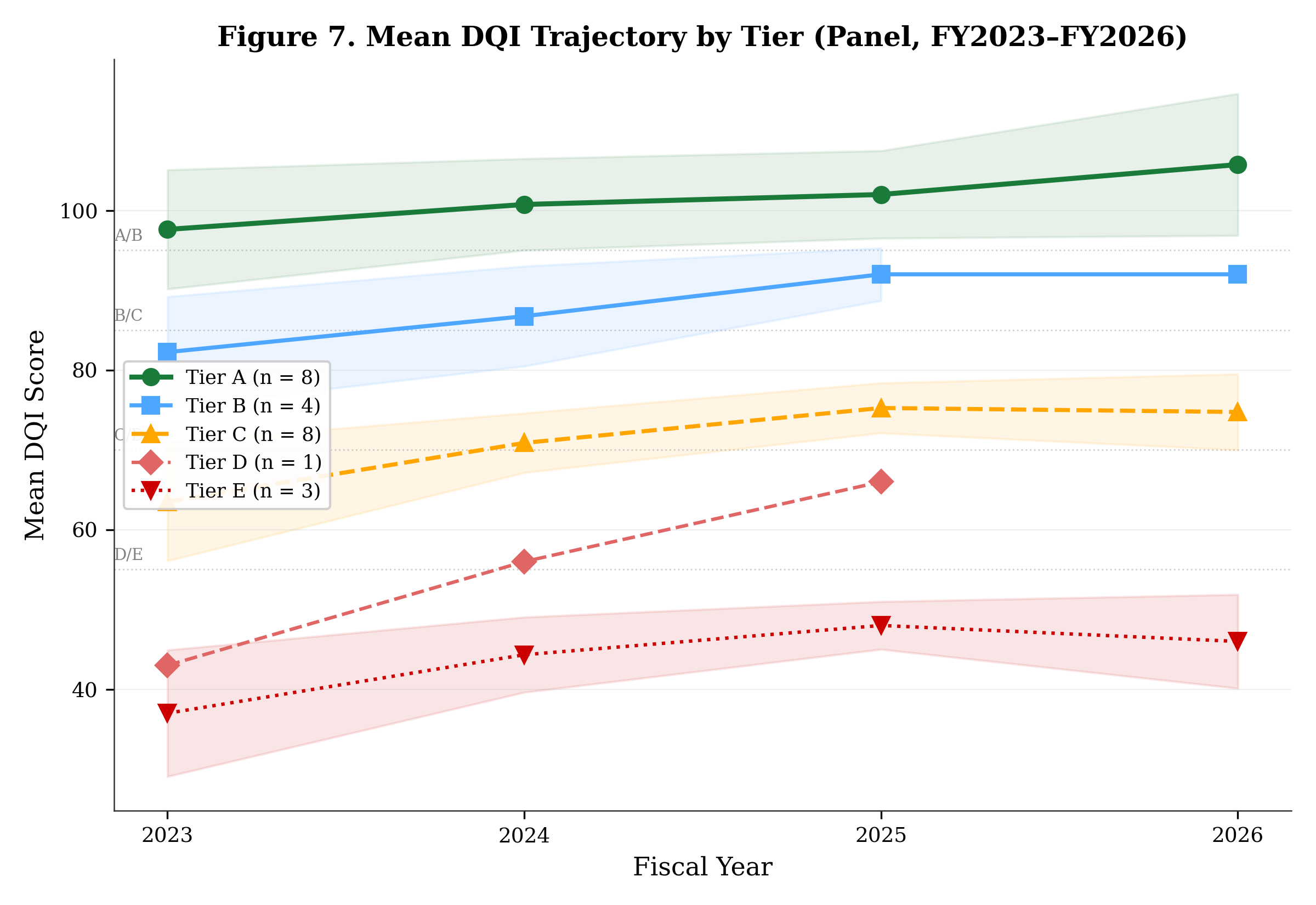
Mean DQI rose from 73.8 to 83.2 over three years (+12.7%), with the largest gains among lower-scoring companies. Companies that adopted external assurance mid-panel showed 10–15 point step-changes. But the bottom quintile — all externally managed, none with SBTi, assurance, or GRESB — shows no convergence path under voluntary frameworks alone.
Methodology
The Disclosure Quality Index is a 120-point instrument comprising 25 sub-indicators across seven dimensions, each scored on a 0–3 scale from "not disclosed" to "fully disclosed with methodology." The DQI scores disclosure quality — not ESG performance. A company with high emissions but transparent, assured reporting scores higher than a company with low emissions but vague, unverified descriptions.
The study population is the complete set of 24 UK listed REITs — a census, not a sample. Each company is scored across four fiscal years (FY2023–FY2026), producing 83 firm-year observations. Panel regression with random effects and entity-clustered standard errors identifies the determinants of disclosure quality.
The scoring codebook (v3.1) is available for research verification from the corresponding author.